How to Read a Dental EOB?
Dental teams lose money when a dental EOB gets skimmed instead of read. A missed adjustment code, a downcoded procedure, or a contractual write-off billed to the patient can leave balances wrong and denials unworked. The fix starts with a repeatable reading order. Check patient and provider details first, then match each procedure line to the submitted claim, confirm its status, and compare billed and allowed amounts. Next, verify deductible, coinsurance, and patient responsibility, and read each group code, CARC, and RARC on its own terms. Finally, reconcile the posted amount against the ERA and the EFT or check. Once the numbers balance, the team can post, correct, bill, or appeal with confidence. This guide walks through each step, with worked calculations, code tables, and an action plan.
Key Takeaways:
- A dental EOB explains how a payer adjudicated a claim, and it is not a bill to the patient.
- Read every EOB in the same order: identity, procedure, status, amounts, patient share, codes, then payment.
- Allowed amount, deductible, coinsurance, and payer payment must reconcile on every service line.
- Group codes assign responsibility, CARCs give the reason, and RARCs add detail, so CO-45 is two codes, not one.
- An in-network contractual write-off is not automatically the patient’s balance.
- Downcoding, bundling, LEAT, and benefit limits often appear only in the remark section, so read it.
- Match the ERA to the EFT or check before posting, then keep the EOB, claim, and chart together for appeals.
A dental EOB tells your team exactly what the payer did with a claim, but only if someone reads it line by line. Many offices post from the totals instead. That is how underpayments, duplicate postings, and wrong patient statements slip through unnoticed.
For many dental practices, outsourcing dental billing process tasks such as EOB review and payment posting is a practical solution once claim volume grows past what the front office can check carefully. The reading method below works the same way whether your in-house team or a billing partner does the work.
Here, we’ll discuss:
- What an EOB contains and how it differs from an ERA and a patient bill
- A seven-step order for reading any dental EOB
- How to calculate insurer payment and patient responsibility
- How group codes, CARCs, and RARCs work
- What to do next for paid, adjusted, and denied claims
Get Professional Dental EOB Reviews for Accurate Payment Posting and Smooth Finances
What is a Dental EOB and What Does It Tell You?
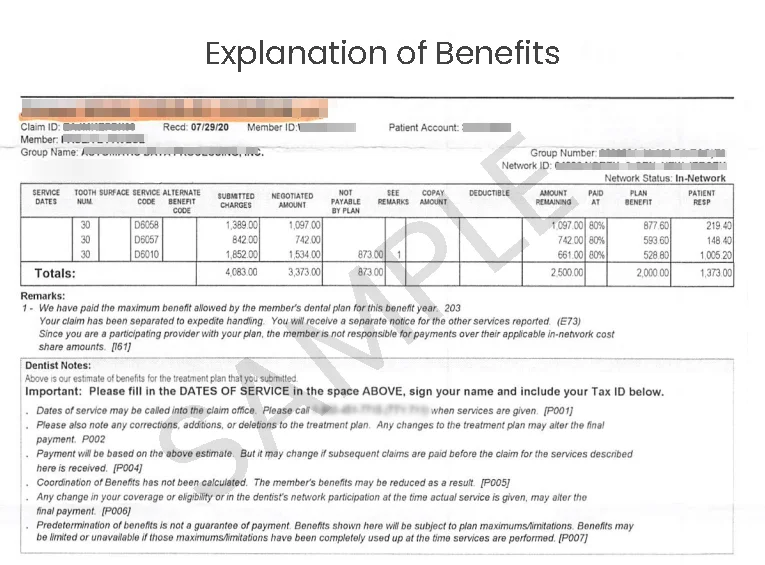
Short Answer: A dental explanation of benefits is a written statement sent to the beneficiary after a payer adjudicates a claim. It shows which charges the plan covered and which it did not.
For a billing team, a dental EOB answers seven practical questions:
- Which procedures did the payer process?
- What fee did the practice report?
- What amount did the plan allow?
- What did the plan pay?
- What adjustments did the payer apply?
- What does the plan say the patient owes?
- Why was a line reduced or denied?
Payers use their own layouts and labels. Note that every EOB doesn’t use the same terms, but each one should explain the same information clearly.
EOB, ERA, and Patient Bill: Three Different Documents
| Document | Main recipient | Purpose |
|---|---|---|
| EOB | Patient (beneficiary), often copied to the office | Explains the benefit determination |
| ERA | Provider | Delivers payment and adjustment detail electronically, using the HIPAA-adopted X12 835 transaction |
| Patient statement | Patient | Requests payment for the balance the practice can legitimately collect |
X12 version 5010 (835) is the adopted standard for the ERA transaction. Because the 835 is structured data, practice management software can read it and post payments automatically.
What is Changing With Dental EOB Standards
In July 2026, the ADA released Proposed ANSI/ADA Standard No. 1120-4 for public comment. It defines the data an EOB should carry so practice systems, payers, and intermediaries can exchange adjudicated claim details consistently.
Treat it as a draft until the ADA announces final adoption. It doesn’t change how payers format EOBs today, so your team still needs to read each payer’s layout.
How to Read a Dental EOB Step by Step?
Step 1: Verify Patient and Provider Information
Start with identity. A mismatch here can mean the payer processed the claim under the wrong record.
Check these items:
- Patient name, date of birth, and member ID
- Group or policy number, when shown
- Billing and rendering dentist names
- Provider NPI and tax ID
- Claim number or payer reference number
Also confirm whether the plan is self-funded or fully insured. In its Position on Explanation of Benefits, the American Dental Association (ADA) recommends that EOBs should state this. It’s because state insurance law may apply to fully insured plans while ERISA may apply to self-funded plans. That affects appeal rights and non-covered service rules later.
Step 2: Match Date of Service and CDT Procedure Details
| EOB detail | What to verify |
|---|---|
| Date of service | Matches the treatment date in the chart |
| CDT code | Matches the code submitted and documented |
| Tooth number or area | Matches the treated tooth, quadrant, or arch |
| Surface | Matches the documented surfaces |
| Quantity | Matches units or number of services |
| Description | Matches the procedure performed |
Step 3: Check Claim and Service-Line Status
Assign each line one status:
- Paid in full: Payment matches the allowed amount minus patient share.
- Paid with adjustment: The payer reduced the line for a stated reason.
- Denied: The payer paid nothing on that line.
- Pending: The payer needs more information or is reviewing the line.
A claim can contain lines with different outcomes. A partial payment is not the same as a denial, so work each line on its own.
Step 4: Compare Billed Amount With Allowed Amount
Three terms matter here:
- Billed amount: The fee your practice reported.
- Allowed amount: The reimbursement level the plan set for that procedure.
- Contractual adjustment: The difference between billed and allowed amounts that an in-network dentist writes off under the participation agreement.
A lower allowed amount is not an underpayment by itself. Compare it with your fee schedule on file before you decide whether the payer paid the contracted rate.
Step 5: Identify Patient Responsibility
Locate each patient-owed component:
- Deductible applied
- Copayment
- Coinsurance (the percentage the patient pays)
- Non-covered or excluded charges
- Amounts that depend on another plan’s payment (coordination of benefits)
Then check plan limits that explain why a line paid less than expected. Common ones are annual maximums, waiting periods, frequency limitations, and alternate benefit provisions. Many plans don’t apply the deductible to diagnostic and preventive services.
Any remaining balance due from the patient should be clearly stated on the EOB. If it’s not, verify the amount against the plan terms before billing.
Step 6: Read the Group Code, CARC, and RARC on Each Line
Step 7: Confirm the Insurance Payment and Reconcile It
Finish by matching what the EOB or ERA says to what actually arrived.
- Confirm the line payment equals allowed amount minus deductible, coinsurance, and copay.
- Confirm the claim total matches the sum of its lines.
- Match the ERA to the EFT or check using the trace number.
- Remember that one deposit can cover many patients, so never post a whole deposit to one account.
- Look for provider-level adjustments, such as recoupments, that can change the deposit total without appearing on a patient claim.
Post only after these checks pass. Also check previously posted remittances, because payers sometimes send the same EOB twice.
Quick 7-Step Table to Read and Review Explanation of Benefits
| Step | What to Check | What to Confirm |
|---|---|---|
| Patient and Provider Details | Patient name, DOB, member ID, group number, dentist, NPI, tax ID, and claim number | Information matches the patient record and submitted claim. Identify whether the plan is self-funded or fully insured. |
| Date and Procedure Details | Date of service, CDT code, tooth number, surface, quantity, and procedure description | Each EOB line matches the submitted claim and clinical documentation. Record any payer code changes. |
| Claim and Line Status | Paid in full, paid with adjustment, denied, or pending | Review each service line separately. A partially paid claim is not necessarily denied. |
| Billed and Allowed Amounts | Billed fee, allowed amount, and contractual adjustment | Compare the allowed amount with the applicable fee schedule before identifying an underpayment. |
| Patient Responsibility | Deductible, copay, coinsurance, non-covered charges, and coordination of benefits | Verify patient balances against plan terms, annual maximums, waiting periods, frequency limits, and alternate benefit provisions. |
| Adjustment and Remark Codes | Group code, CARC, and RARC | Read the codes together to understand why a payment was reduced or denied and what action is required. |
| Payment and Reconciliation | Line payments, claim total, ERA, EFT or check, and trace number | Match the remittance to the deposit, account for provider-level adjustments, and check for duplicate postings. |
How to Calculate Insurance Payment and Patient Responsibility on Explanation of Benefits?
In-Network Covered Procedure
Plan payment plus patient payment (deductible plus coinsurance) equals the plan’s maximum allowable fee.
Assume an 80 percent benefit after a $50 deductible.
| Component | Amount |
|---|---|
| Billed fee | $1,000 |
| Allowed amount | $800 |
| Deductible | $50 |
| Amount subject to coinsurance ($800 minus $50) | $750 |
| Plan payment (80% of $750) | $600 |
| Patient coinsurance (20% of $750) | $150 |
| Total patient responsibility ($50 plus $150) | $200 |
| Contractual adjustment ($1,000 minus $800) | $200 |
| Total accounted for ($600 plus $200 plus $200) | $1,000 |
Out-of-Network Covered Procedure
Plan payment plus patient payment (deductible, coinsurance, and balance) equals the dentist’s full fee.
Using the same numbers, the plan pays $600. The patient owes the $50 deductible, $150 coinsurance, and the $200 balance, which totals $400. The office is entitled to its full fee because no participation agreement limits it.
Some out-of-network EOBs apply fee limits or show $0 patient responsibility even though the payer did not pay the full fee. Such an EOB is incorrect and should be challenged. Out-of-network estimates should be based on the dentist’s full fee and clearly labeled as estimates, not guarantees.
Non-Covered Procedure
A non-covered service is a procedure the plan excludes. It shouldn’t be confused with a bundled, downcoded, or alternate-benefit procedure.
For in-network dentists:
- In states with non-covered service laws, the patient pays the dentist’s full fee.
- In states without those laws, the patient pays the plan’s maximum allowable fee.
Check your state’s rule and your contract before billing the patient for a non-covered line.
Coordination of Benefits
Adjustment Group Codes, CARCs, and RARCs Explained
| Code type | Question it answers | Example |
|---|---|---|
| Group code | Who is financially responsible? | CO, PR, OA, PI |
| CARC (claim adjustment reason code) | Why was the amount adjusted? | 1, 45, 97 |
| RARC (remittance advice remark code) | What additional detail applies? | Payer-specific remark |
Group Codes
| Group code | Meaning | Typical handling |
|---|---|---|
| CO | Contractual obligation | Practice generally absorbs it, under the participation agreement |
| PR | Patient responsibility | Can be billed to the patient |
| OA | Other adjustment | Neither side is assigned responsibility |
| PI | Payer-initiated reduction | Review against plan policy and contract |
| CR | Corrections and reversals | X12 lists it as not used with version 5010 and later |
Common CARCs on Dental Remittances
| CARC | General Meaning |
|---|---|
| 1 |
|
| 2 |
|
| 3 |
|
| 16 |
|
| 18 |
|
| 22 |
|
| 29 |
|
| 45 |
|
| 59 |
|
| 96 |
|
| 97 |
|
| 119 |
|
| 151 |
|
| 197 |
|
| 204 |
|
Two details prevent common mistakes:
- CARC 16 means missing information or a billing error. It does not mean the procedure code was clinically wrong.
- CARC 45 is only valid with group codes CO or PR, and X12 states the amount cannot equal the total service or claim charge. A CO-45 line is usually a fee schedule write-off, not a denial.
Remark Codes (RARCs)
A RARC supplements a CARC or reports remittance processing information. It often tells you what to fix or send. Look up the current wording in the X12 RARC list, and read the payer’s free-text remark section too.
Under the CAQH CORE 360 operating rule, plans must use specific code combinations for defined business scenarios on the 835. CMS has implemented that rule for Medicare. Commercial dental payers still vary, so check each payer’s provider manual.
A Line-Level Balance Check
On every service line, the billed charge should equal payment plus all adjustments. Using the in-network example:
- Billed $1,000
- CO-45 adjustment $200
- PR-1 deductible $50
- PR-2 coinsurance $150
- Payment $600
The adjustments and payment total $1,000. If a line does not balance, ask the payer for a corrected remittance before posting.
What are the Special Adjudication Situations Shown on Dental EOBs?
Downcoding
Downcoding means that a payer reimburses a claim under a procedure code different from the one reported, which lowers the benefit. Dentists must report the CDT code that matches the treatment. Payers decide benefits using plan design, contract terms, and internal policy.
When a payer downcodes the claim, check whether the EOB explains the benefit rule.
If it does and matches the plan, an appeal may not be needed. But if it doesn’t, appeal in writing and keep the clinical records.
Bundling
Least Expensive Alternative Treatment (LEAT)
Benefit Limits and Frequency Rules
What to Do After Reading a Dental EOB?
| EOB Finding | Recommended Action |
|---|---|
| Claim paid as expected |
|
| Contractual adjustment (CO-45) |
|
| Missing or incorrect information (CARC 16) |
|
| Timely filing denial (CARC 29) |
|
| Authorization-related denial (CARC 197) |
|
| Unexpected payment amount |
|
| Patient responsibility looks wrong |
|
| Secondary plan exists |
|
| Duplicate EOB or remittance |
|
Appeal Timing and Process
File appeals in writing and follow the payer’s stated process. Skipping the written appeal step can usually bar further recourse.
For group health plans covered by ERISA, the Department of Labor claims rule requires at least 180 days to file an appeal after an adverse benefit determination. For post-service claims with one level of appeal, the plan generally must decide within 60 days of receiving the appeal.
Fully insured plans may follow state rules and plan contract terms that differ. Read the plan documents and your provider agreement for the controlling deadline, and keep a calendar of every dispute.
Include these items in an appeal:
- Copy of the original claim and the EOB or ERA
- Treatment notes, radiographs, and narratives
- Fee schedule or contract pages, when relevant
- Payer reference numbers from earlier calls
- A concise statement of what you want corrected
Keep the Documentation Together
Store the claim, chart notes, EOB, ERA, and payer communications in one place. This supports:
- Faster comparison during posting
- Duplicate detection
- Appeals with complete proof
- Pattern reviews that show which payers or codes cause repeat problems
Make Your Dental EOBs Effective with Quick Appeals for Denials & Payment Posting for Reimbursement
What are the Common Mistakes When Reading a Dental EOB?
| Common Mistake | Recommended Fix |
|---|---|
| Treating the EOB as the final patient bill |
|
| Moving every unpaid amount to patient responsibility |
|
| Confusing a contractual adjustment with a denial |
|
| Ignoring line-level codes and reading only the claim total |
|
| Posting a duplicate payment without checking earlier remittances |
|
| Posting a coordination of benefits write-off before every plan has paid |
|
| Accepting a downcoded line without reading the remark section |
|
How to Let a Billing Partner Handle EOB Review and Posting?
EOB work grows with every payer you add. Each payer has its own layout, code usage, and remark language. Staff members must read lines, balance amounts, post, and follow up, all while the front desk keeps patients moving.
Handing over the dental billing and coding process to an expert can address that workload in three ways:
- Consistent review: One written reading sequence applies to every EOB and ERA.
- Faster follow-up: Underpayments and denials get assigned the day they are found.
- Cleaner records: Payment posting, adjustments, and appeal files stay organized by claim.
A partner like TransDontics supports dental practices with payment posting, claim follow-up, denial management, and automated billing workflows. If you consider any partner, ask how they verify allowed amounts against your contracts, how they separate CO and PR amounts before patient billing, and how they report denial trends back to you.
Get Accurate Dental EOB Reviews and Payment Posting for a Smooth Revenue Cycle
Conclusion
Frequently Asked Questions
Is a dental EOB a bill?
What does the allowed amount mean on a dental EOB?
What does CO-45 mean on a dental EOB?
What is the difference between an EOB and an ERA?
Why is the insurance payment lower than the billed amount?
Should I post payment straight from an EOB?
Sources
- American Dental Association, How to Read Your Explanation of Benefits (EOB) Statement
- American Dental Association, ADA Position on Explanation of Benefits (EOB) Statements
- American Dental Association, Model Explanation of Benefits Statement
- Centers for Medicare & Medicaid Services, Operating Rules for EFT and Remittance Advice
- U.S. Department of Labor, 29 CFR § 2560.503-1: Claims Procedure
- X12, Claim Adjustment Reason Codes
- X12, Remittance Advice Remark Codes