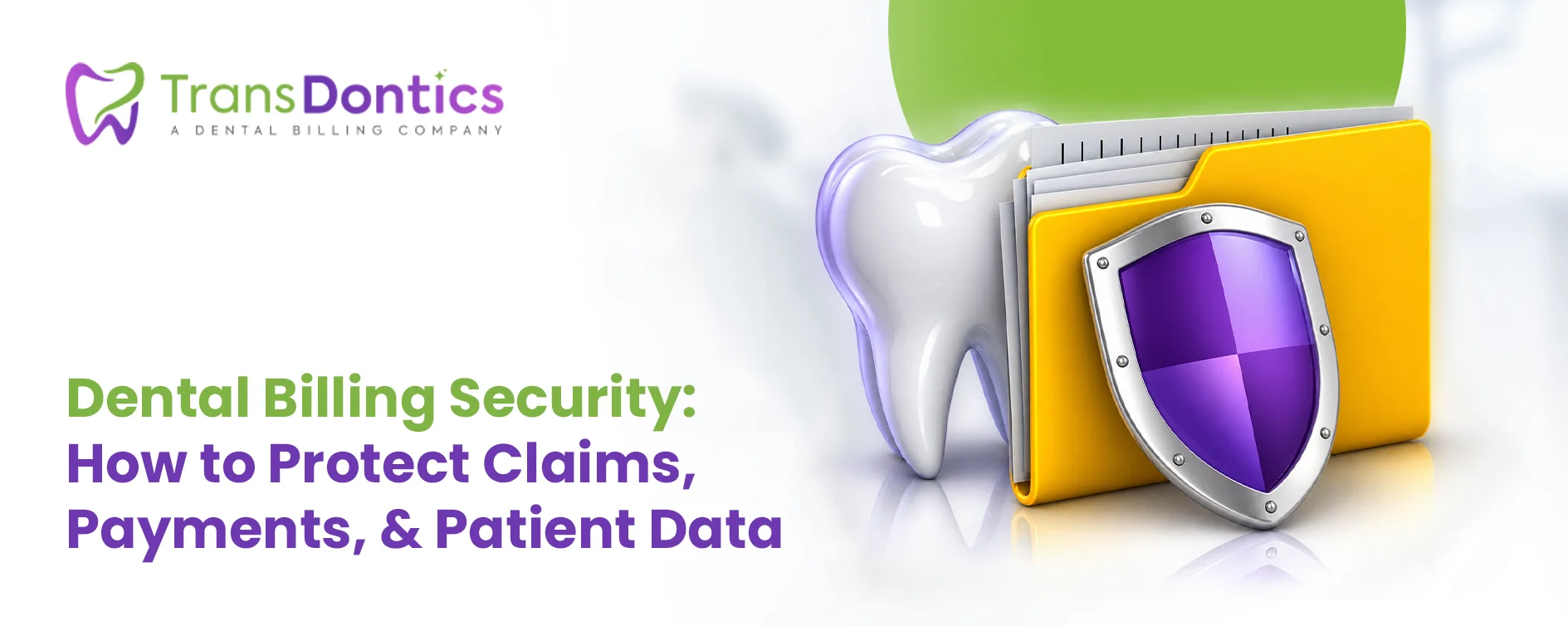
Dental Billing Security: How to Protect Claims, Payments, and Patient Data
Key Takeaways:
- Dental billing security protects both revenue and patient data. A vulnerability at any point in the claims process can disrupt submissions, payment posting, and A/R follow-up.
- The eAssist incident remains unconfirmed. A ransomware group’s leak-site listing is not proof of data theft, but practices should review access and prepare to respond without waiting for a final determination.
- HIPAA security starts with risk analysis. Covered entities and business associates must address risks to electronic protected health information (ePHI), supported by appropriate safeguards and written business associate agreements.
- Strong access controls reduce preventable risks. Require MFA, unique user accounts, least-privilege access, timely offboarding, encryption, and regular audit-log reviews.
- A secure billing vendor must show evidence, not promises. Verify its BAA, subcontractor practices, independent security assessments, incident-notification timelines, tested backups, and data-return procedures.
- The first 72 hours after an incident notice matter. Revoke stale access, rotate credentials, enable MFA, preserve suspicious logs, notify relevant staff, and prioritize claims nearing filing deadlines.
- Security planning must follow the revenue cycle. Map systems and vendors, document risks, test downtime procedures, review access quarterly, and maintain a response plan that protects claims, payments, and patient information.
Dental billing security decides whether your claims move, payments land, and patient data stays private. Every claim passes through a practice management system, a clearinghouse, a payer, and often an outside team. Each handoff is a possible way in for an attacker.
That’s why getting reliable dental billing services is no more a luxury for practices, but a must. One weak login at a vendor can stall claim submission, freeze A/R follow-up, and delay deposits. The recent alleged data breach on eAssist Dental Solutions in September 2026 showed how quickly that becomes your problem.
This guide covers what happened, what’s still unconfirmed, where billing data can leak, which HIPAA rules apply, and how to judge a billing partner’s safeguards. You’ll also get a response plan and a free planning guide.
Why Dental Billing Security Matters More in 2026?
Billing data is a rich target because it bundles identity, insurance, and money in one place. A single claim can carry a patient’s name, birth date, subscriber ID, procedure codes, and payer details. That’s everything a fraudster needs, which is why attackers keep coming back to healthcare.
The numbers back that up. Here’s where the 2026 evidence on security stands.
| Signal | What the data shows | Source |
|---|---|---|
| Attack volume | Healthcare and public health logged 460 ransomware and 182 data breach complaints in 2025, the most of any critical infrastructure sector. | Federal Bureau of Investigation’s 2025 Internet Crime Report |
| Cost | The average healthcare breach cost $6.64 million in 2026, down from $7.42 million but still the costliest industry for the 13th year. | IBM’s Cost of a Data Breach Report 2026 |
| Cause | 59% of healthcare breaches in the study were malicious or criminal attacks. | |
| Dental exposure | DentaQuest reported a May 2026 breach affecting about 15 million people, with billing information among the data involved. | HIPAA Journal’s July 2026 Piece: “DentaQuest Starts Notifying 15 Million+ Individuals About May 2026 Cyber Incident” |
| Enforcement | By April 2026, HHS Office for Civil Rights (OCR) had completed 19 ransomware investigations and 13 Risk Analysis Initiative cases. | U.S. Department of Health & Human Services (HHS) April 2026 Press Release: “HHS’ Office for Civil Rights Settles Four HIPAA Security Rule Ransomware Investigations” |
Look closely at OCR’s April 2026 settlements. The failures weren’t exotic. Investigators repeatedly found that the organization never completed an accurate, thorough risk analysis. Even Consociate Health, a business associate, paid $225,000. Basics get people in trouble.
What the eAssist Incident Means for Dental Practices?
Here’s what’s on the record for the alleged eAssist ransomware attack as of this writing. The tracker Ransomware.live logged DireWolf’s listing of eAssist on September 6. The Georgia Dental Association reported that eAssist told customers on September 8 that it was investigating a potential information security incident with outside experts.
The table below breaks down all these incidents in a sequence, presenting a complete timeline of events.
| Event | Status |
|---|---|
| Listing on DireWolf’s leak site, Sept. 6 | Trackers confirm the listing exists. That isn’t proof that data was stolen. |
| Access to eAssist’s internal systems | Claimed by DireWolf. Not independently verified. |
| An investigation | Confirmed by eAssist: a potential information security incident, outside experts engaged, investigation ongoing. |
| Customer or patient data exposed | Not confirmed. eAssist said it will notify affected parties as required. |
| Guidance to customers | Change system passwords and remove old or inactive accounts tied to practice management software, clearinghouses, claims software, and portals. |
Note: A leak-site listing is an accusation, not a finding. But your response plan shouldn’t wait for the verdict. You must act proactively to protect your data and revenue.
Here is what practices must learn from this event, even if it’s alleged one:
A vendor’s problem becomes your workflow problem
Old accounts are open doors
Don’t assume a breach, and don’t assume you’re safe
Where Security Risks Hide in a Dental Claim Journey?
Follow one claim from start to finish and you’ll see how many places information can slip out. Most incidents don’t look like a movie hack. Good security practices in dental billing follow the claim, because that’s where the ordinary gaps are.
| Stage | Information exposed | Weak spot | Control that helps |
|---|---|---|---|
| Eligibility check | Name, birth date, subscriber ID | Payer portal logins shared across the team | Unique named logins with multi-factor authentication (MFA) |
| Claim creation | Codes, narratives, X-ray attachments | Attachments sent by regular email | Encrypted transfer or clearinghouse attachment tools |
| Clearinghouse submission | Full 837D claim file | Old or shared clearinghouse users | Quarterly access review, same-day offboarding |
| Payer response and ERA | Payment amounts, patient responsibility | Downloaded files left on shared drives | Restricted folders and audit logs |
| Payment posting | Bank details, EFT enrollment | Fake “update our bank info” requests | Phone callback for any payment change |
| Statements and collections | Balances, contact details | Unsecured texts, emails, payment links | Approved secure channels, minimum necessary data |
| A/R follow-up and appeals | Chart notes, EOBs | Remote access tools, personal devices | Managed devices, VPN with MFA, session timeouts |
Payment redirection deserves special mention. Business email compromise ranked among the highest-loss complaint types in the Federal Bureau of Investigation’s 2025 Internet Crime Report. One convincing email asking your biller to change deposit details can send a week of collections to the wrong account.
What are the HIPAA Rules That Shape Security Protocols for Dental Claims?
HIPAA gives you a legal frame. The Security Rule requires administrative, physical, and technical safeguards for electronic protected health information, covering its confidentiality, integrity, and availability. The billing process fits exactly here.
Risk analysis comes first
Your billing vendor is a business associate
Breach notification and the ransomware presumption
What about the proposed Security Rule update?
What are the Core Controls for Protecting Claims, Payments, and Patient Data?
Lock down logins
HHS’s voluntary Cybersecurity Performance Goals give you a practical shortlist to choose a secure dental billing infrastructure. The essential goals target identity-based attacks, which cause the most damage. Here’s how they’re important to keep your cash flow and compliance both on the right track.
Give people the least access they need
Encrypt and keep logs
Plan for the bad day
Train for the emails you’ll actually get
How to Vet a Dental Billing Vendor’s Security Standards?
Outsourcing billing shifts the work, not the accountability. Before you sign, or at your next renewal, ask direct questions and expect specific answers. Vague reassurance is a warning sign. Strong dental billing security should be easy for a vendor to explain.
In the table below, we’ll describe some of the questions you must ask your vendor to evaluate their security posture, with answers to expect from a reliable billing partner.
| Ask this | A strong answer |
|---|---|
| Will you sign a BAA, and who are your subcontractors? | Signs promptly, names every subcontractor and any offshore access, and passes HIPAA duties down to each one. |
| How is access controlled? | MFA on all systems, unique named accounts, least-privilege roles, same-day offboarding, and access logs available on request. |
| What independent proof can you share? | A recent risk analysis plus a third-party assessment such as SOC 2, shared under NDA. |
| How is our data encrypted and separated? | Encryption in transit and at rest, with logical separation between clients. |
| How fast will you tell us about an incident? | A contractual window far shorter than HIPAA’s 60-day limit, for example 24 to 72 hours, with named contacts. |
| How do claims keep moving in an outage? | A tested continuity plan with backups, alternate submission routes, and defined recovery targets. |
| What happens to our data if we leave? | Documented return and secure deletion, confirmed in writing. |
Also ask how the vendor handles your credentials. A partner that requests full admin logins to your practice management software, instead of scoped accounts, creates risk you’ll inherit. Least privilege should apply to your billing partner just as it applies to your own staff.
Want a second set of eyes on your current setup?
What to Do in the First 72 Hours After a Vendor Incident Notice?
If a billing partner reports an incident, move fast but stay organized. Here is a solid action list for any vendor event.
- Change passwords for your practice management software, clearinghouse, claims software, and payer portals. Use new, unique ones.
- Remove old or inactive accounts, including remote access.
- Revoke active sessions, saved credentials, API keys, and integrations. A password change alone may not end them.
- Turn on MFA everywhere it’s available.
- Review recent login activity, and save suspicious logs before making more changes.
- Record when you were notified, which accounts the vendor could reach, and what you changed.
- Warn staff about phishing tied to claims, password resets, or payment changes.
- Flag time-sensitive claims and appeals so nothing misses a filing deadline.
How to Build a Billing Security Plan Around Your Revenue Cycle?
The dental billing security plans that last mirror the workflow your team already runs. Draw the path your data takes, assign an owner to each control, set a review date, and keep proof it’s happening. Our companion guide turns that into seven steps and a printable checklist:
- Map every system and vendor that touches billing data
- Assess risk in writing and update it yearly
- Tighten logins, roles, and offboarding
- Protect data in storage and in transit
- Vet billing partners against a scorecard
- Rehearse your incident and downtime response
- Review access and vendors every quarter
Get the seven-step plan and checklist to ensure secure dental billing services
Final Thoughts
Dental billing security isn’t a one-time project. It’s a habit built into how claims are verified, sent, paid, and followed up. The eAssist claim is still unproven, but the lesson isn’t: know who uses your billing data, limit access, and rehearse your response.
Switch to a partner, like TransDontics, who shows evidence, not promises. You get a guarantee on all the protocols powered by reliable cybersecurity systems. Plus, there is direct transparency, as you can access your portals, while you retain your access, and your billing partner processes claims, and you can see how your systems are managed.
With HIPAA compliance and SOC 2 certification, you get a reliable partnership that protects your claims, revenue, and patient data.
Ready to secure your billing setup?